Sean Maika
Champion Showcase Profile
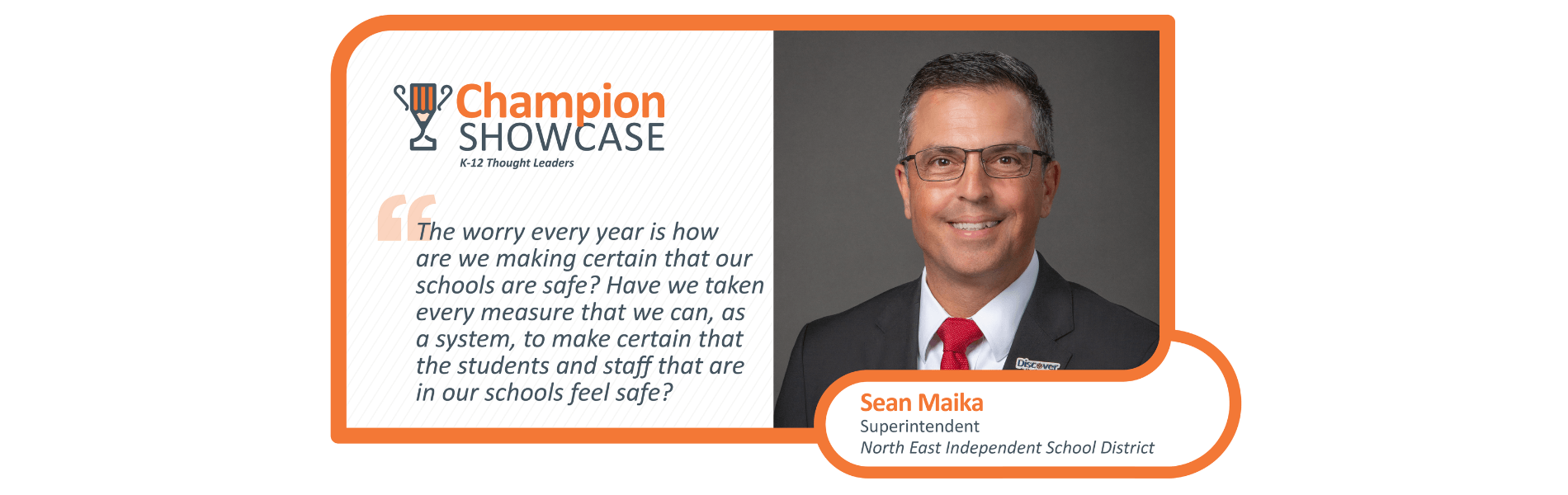
What is your number one concern for this school year?
In 2013 when I was a principal, I met my current Chief of Police. When we talked about school shootings and threats like that at that time, he told me that it wouldn’t happen on his watch. About three years ago, that changed to “when it happens” on his watch. So, for me the worry every year is how are we making certain that our schools are safe? Have we taken every measure that we can, as a system, to make certain that the students and staff that are in our schools feel safe?
That has always been and will continue to be my number one concern. Back when I graduated, I didn’t take any safety classes, and nobody talked about safe schools because people felt schools were safe then. That’s not what it is today. This morning, I had a principal meeting and started it off with what just happened in Georgia. Those tragedies today have such a far-reaching impact because they unsettle everyone.
The more that we all understand, and our messaging in the school district is, that safety is not my Chief of Police, or my Senior Director of Safety and Security, or my job, it’s all of our jobs.
What we’re always communicating is that from our students all the way through our community members, and everyone in between, it’s everybody together collaborating, that creates a safe environment.
What do you see as the role of technology in education?
Technology should complement the curriculum in teaching, it shouldn’t be the curriculum in the teaching. Good technology is incorporated when it amplifies the learning, doesn’t take away from the learning.
What I’ve seen over my 30-year career, is often people are using technology for the sake of technology, not really trying to integrate it in the lesson to amplify what it is. Whether it’s safety or anything else, technology will never replace the human interaction that students need.
If anything, we learned through COVID, and the isolation, that people need human interaction. When we look at the use of technology, it shouldn’t be trying to replace people or teaching, but how does it complement the learning that’s happening and how does it enrich the lesson, not take away from the lesson.
What are you seeing in terms of staff retention or staff shortages?
When I earned my doctorate, I studied organizational climate as part of my dissertation. The climate of our facilities in our districts is important.
We’ve struggled somewhat with retention, I don’t know if we’re any worse off than we were, but what has come out of COVID is a big shift. In Texas, the state has not given us any new money to increase pay, and inflation is hitting, so we’re seeing people leave the field of education to go into industry at a rate that’s not that we’re not accustomed to. Industry is also hiring educators at a rate that we’re not accustomed to. What they’re finding in this labor shortage is that teachers show up, they don’t mind PD, they work hard, and they’re there to do the right work. Which ultimately makes them very hirable.
We’ve had somewhat of a retention piece, but quite frankly when I did convocation about a month ago, and met with teachers at all seven high schools, the average years of experience in the room was still over 20 years.
The struggle isn’t about retention, it’s finding new folks that are prepared for teaching. That’s the piece we focus on. I don’t believe we have a teacher shortage. I think we have a teacher-quality shortage because what’s coming up through the pipeline doesn’t appear to be as prepared as years past.
How do you and your leadership team go about cultivating a climate in support of mental health?
In 2019 when I became the Superintendent, I had three priorities, hire and retain the best, compete in educational marketplace, and the mental health of our students and staff. I often joke that we were focused on mental health before mental health was cool to focus on. We did a lot of things not just for our students, but also for our teachers and our employees throughout the district.
Climate is everybody’s job. That was my message this year at convocations. How we all show up to work each day is a piece of creating a climate that people want to be a part of. When folks are struggling, we call it the invisible backpack that they carry. None of us know what’s in that invisible backpack of problems that people carry with them. Whether that’s a child or an employee, rather than reacting in the system, which often is punitive, first we want to understand why a child, or an adult is acting that way.
I’ll give you an example. We piloted a program here in Bear County, that’s now in every school district, called Handle with Care. When an officer shows up to a home and a child has experienced a traumatic event such as spousal abuse, they were abused, or something very horrific, that law enforcement agency contacts a point of contact in our district. They tell us tomorrow when this child shows up to school, handle them with care. They don’t tell us what it is. They don’t tell us what happened, but we know that child had a traumatic event.
When the child shows up to school, often that trauma manifests itself as acting out. They may be tired and sleeping in class. Rather than lead with discipline and say, “Get your head up.” We might say, “Hey, can you go down to the nurse’s station? Why don’t you go take a rest? Are you hungry?” It’s taking care of those types of things because that’s leading with the heart and that’s what educators do rather than with a rod.
It’s quite sobering when you see the number of those calls a year that we get as a system. The good news is, and I’ll tell you the way the principal says it, is that it has had a tremendous impact because her discipline has gone down at her campus. Her negative interactions with parents have dropped because all of a sudden, we started to understand what was in that invisible backpack and could lend support rather than punishment. It changed the dynamic.
Long term, what is your strategic vision for your district?
We developed that about two years ago, and it’s called a balanced district scorecard. It focuses on four key aspects: students, staff, stakeholders, and stewardship. What I’m very proud of, the board at the time that created it, was very purposeful about choosing the four S’s because it was easy for everyone to remember.
From that, they identified key objectives they wanted us to work on. We then validated that in our community. It’s great if the board and I are aligned, but ultimately, we have to answer to our faculty, our kids, and our parents. We used focus groups to ask, “Did we get it right? Are these the areas you want us to focus on?” They gave us feedback, we made some adjustments, and that is the work. Five years out, and really 10 years out, we will continue to work on that document.
What makes it different than a strategic plan is the word balance. All four of those priorities are of equal value. If this is great for students, but inadvertently would hurt stewardship and staff, then we really need to think through that because it shouldn’t be good for just one priority. We have to balance all four priorities.
That’s how we approach all our thinking when we look at it. It gives us the freedom to say yes to things that align with the scorecard, but it also gives us the freedom to say no to things that don’t. If you want to see a copy of it, you can go to our website, under the Board of trustees, you can click on it and review the entire document. Once a quarter we update the board and our community about where we’re at on the progress of it.