Kelly Rozelle
Champion Showcase Profile
What is your number one concern for the 2023-2024 school year?
My major concern is graduation rate because our numbers are connected to the actual high school. So, I want to make certain that all my students that are scheduled to graduate with this cohort actually meet their graduation requirements and are able to graduate in the spring. That is my primary concern.
What’s your vision and the district’s vision for the next five years?
We want to keep our numbers up because when we went through COVID, people were kind of all over the place with the state report card. As we move out of COVID, that report card comes back into focus and people have to really be held accountable for those numbers.
You have to be strategic with how you’re planning to work on student attendance, how you’re planning to work on your graduation rate, and there’s always that piece about your discipline in those numbers.
You want to kind of just keep your finger on the pulse of all of that and continue to move your young people forward despite a lot of these other things that we have a hard time controlling. Some of these are factors that are outside of our realm of responsibility or things that we can actually manipulate. We handle what we can and just continue to move forward.
How do staff shortages or teacher retention affect your district?
Those are issues and concerns on the national level. But again, that’s something that you really can’t control. You have to continue to move forward and that’s where we have the ability and the flexibility to use our support people, like instructor assistants.
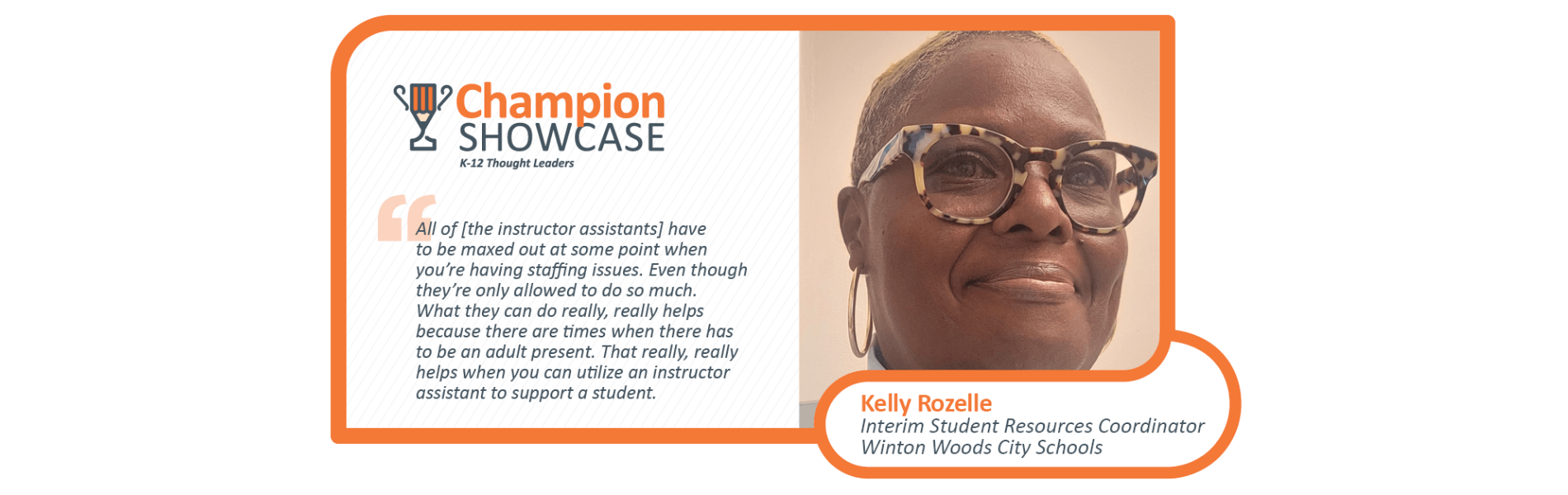
All of those folks have to be maxed out at some point when you’re having staffing issues. Even though they’re only allowed to do so much. What they can do really, really helps because there are times when there has to be an adult present. That really, really helps when you can utilize an instructor assistant to support a student.
If you need to move that student away from the major group to have a conversation or to do what needs to be done, you have that flexibility because you can’t always remove the teacher from those settings. The teacher is there to manage the rest of the class and to continue with the instruction. It’s nice to have those kinds of options.
What does Winton do to promote the mental health of staff and students?
The district just rolled out something this summer. They wanted spots, like a relaxation room, for the adults and a lot of stuff was donated for that room—brain teasers, stress balls, puzzles, coloring books, notebooks and journals, a punching bag, there’s a lot of stuff in there. I’m in the process of getting a furniture company to donate rental furniture for that room. If teachers need to decompress, they can go in there during their break. I’m going to provide that space.
Now we have another area, that is usually our pantry, for our program. Kids can go in there and decompress if they need to take some time. An adult can sit in there with them.
They can also come to my office, which is not a traditional office. My office is a classroom, so it’s really, really big. They can come in here, hang out for a little bit, get themselves together. Because that mental health piece is more than a notion.
Sometimes it can be something as simple as, “Can I just sit and put my head down, away from the rest of my class, away from my teacher? Can I just get some time away?” That’s doable.
“Can I go outside?” Yes, somebody will walk you outside. You can sit on the steps, walk around the community to disconnect, and move away from everything else, and just kind of get yourself together. I get it. You’re human. And this can be extremely stressful.
I, as a teenager, I can’t imagine having the access that they have, with all this social media. I honestly cannot imagine. I try to be extremely flexible when it comes to those kinds of situations.
What about the safety of student athletes and you know the prioritization of that; what products, assets, and training do you put in place for the students and the staff coaches?
That’s interesting that you would ask that question because people struggle, and you have to keep it on the same plane. A lot of people put their student athletes up here and everybody else is down here. We have to move together because the kids have to feel OK about what’s going on. And if you constantly make special provisions for your athletes, that becomes problematic.
They’re student athletes. They’re students first. So we’re going to move in that same vein. Any additional support that they need is nothing more than what any other student would get.
The only thing is they spend, because of what they do, more time in this physical space, so we have to make sure there are plans in place to make sure that they’re fed because those athletic activities extend the school day. We need to make sure that they’re eating; be it parent groups or donations from whomever. But we got to make sure they’re eating.
Our staff and coaches focus on the same thing. If they’re not fundraising to have the compensation to cover those, the district comes out of pocket and does whatever needs to be done to make sure that these young people eat, that the coaches have whatever they need to provide safety. Of course, we have to do all of that necessary training—CPR, bleed, all of that required training. And the state makes sure that your credentials are up to date. You get notified through ODE, if your stuff is near expiration, they’ll reach out to you. But we take really, really special care to make sure everybody’s prepared who’s managing and handling student athletes, too.
What do you see is the role of technology at Winton?
Definitely reduction in the purchase and the money spent on materials. That is a huge improvement. We’re not spending money on all of these consumables and books. Everything is in the computer, and we have the one-to-one program, so every student has one device. They’re taking those devices home every day.
At one point we were we were keeping them here and they had Chromebook carts and they would turn them in at the end of the day. They would stay on the cart overnight, recharge. Then we say, hey, real life is you’ll have that device with you. It’s your responsibility to make sure it’s charged. It’s your responsibility to make sure that you bring it to school every day.
But we do have tech stations in every building where the tech staff is the majority of the time if you have a tech issue. I think it really kind of puts us in the running for the real world. I really do because everything is going so high tech. You need to be prepared for that. And things are evolving and changing so quickly. And these young people are not intimidated by technology and that’s definitely a plus.
They are a lot savvier than we are as adults most of the time because they’re patient and play. They’re somewhere trying to figure out how they can over and out do a firewall. It’s in a fast-paced environment and they’re keeping up so that’s a good thing.
Are they always doing what they’re supposed to be doing? Absolutely not. But that thought process and the thinking to try to outdo, that’s a good thing if put in the right place. So I like it that they do experiment and try to figure out how to do different things that they’ve not been taught to do. That’s the good side of it.
Nominate a district leader we should showcase!
Is there a leader in your district or a neighboring district who is an innovator pushing their district forward? We want to showcase them! Drop their information below and we’ll do the rest.