Dr. Andraé Townsel
Champion Showcase Profile
What is your number one concern for the 2023-2024 school year?
My number one concern for the upcoming school year is where the community’s trust is.
As you know, prior to this school year and in the previous year, we were in a pandemic and emerging from a pandemic and we saw how politicized public school has been across the country.
So, my major concern is to wonder what is the pulse on politics with regards to trusting school systems with young people?
Prior to the pandemic it felt like school districts across the country were moving in a certain direction. When home schooling came into place, along with the shutting down of schools, and the closer scrutinization of curriculum, I felt like schools have been mistrusted. There are still really great people in the field of education; great people that want to support young people, who want to positively change the trajectory of young peoples’ lives, in some cases are victimized by the political landscape, in some cases of just public education.
What is your vision for the district in the next 5 years?
We’re working on a strategic plan now and I expect to have that strategic plan brought to our Board of Education, December ‘23 and approved for implementation January of ‘24.
But my plan is very simple, and I say it all the time.
Our goal is to set the bar, meet the bar, exceed the bar, and raise the bar all the way across the board— whether we’re talking about academics, whether we’re talking about behavior, whether we’re talking about young people’s social and emotional capacity. Raising the bar across the board. Also enhancing the student experience while increasing academic achievement.
When I say set the bar, meet the bar, exceed the bar, raise the bar, I’m talking about at minimum 1% better in everything that we’re doing. So, my goal in the next five years is to show a track record of achievement overtime.
I often ask, “Approximately how tall does a tree grow?” People give answers like “20 feet”, “30 feet”, “Depends on the tree.” “What kind of species?”
But the answer is the tree grows as high as it possibly can grow. So, it’s our goal to provide education, while young people can achieve as much as possible, based on the education that they receive. It’s a variable that’s unaccounted for, and that variable is called until.
How long will you give a baby to learn how to walk?
The answer is until the baby learns how to walk. Maybe that’s 10 to 11 months, maybe that’s 12-13 months until the child learns to walk. That’s the philosophy that I like to lead with.
How do you see the role of technology in education?
I actually met with our IT department of over 35 individuals that support IT in our district, this morning. We have the number one IT department in the state of Maryland, and one of the top in the country.
But technology plays a major role in keeping young people safe with cyber security and from cyber-attacks to keep our district and data safe, but also it gives us access to more resources at a faster rate.
Also, it gives us an opportunity to potentially teach etiquette with regards to using technology and social media, to an extent, while we encourage our schools and different building leaders to utilize social media to promote a lot of positive things happening in their communities.
We must realize that young people access that technology as well. So, are there opportunities to teach etiquette on how to use social media? What are the opportunities to educate young people on the dos and don’ts of social media?
Because what you put out over cyberspace stays there forever, no matter what you do, there is nothing you can do about it. You cannot erase it. It lives there.
For the first time, probably in the history of mankind, memory lives. Back in the day, you could only interpret from writings and pictures on the wall, but now you can see video—you can see and hear for yourself. There’s no more folklore, no more legend or myth, it is what it is. So, it’s really making people aware of that.
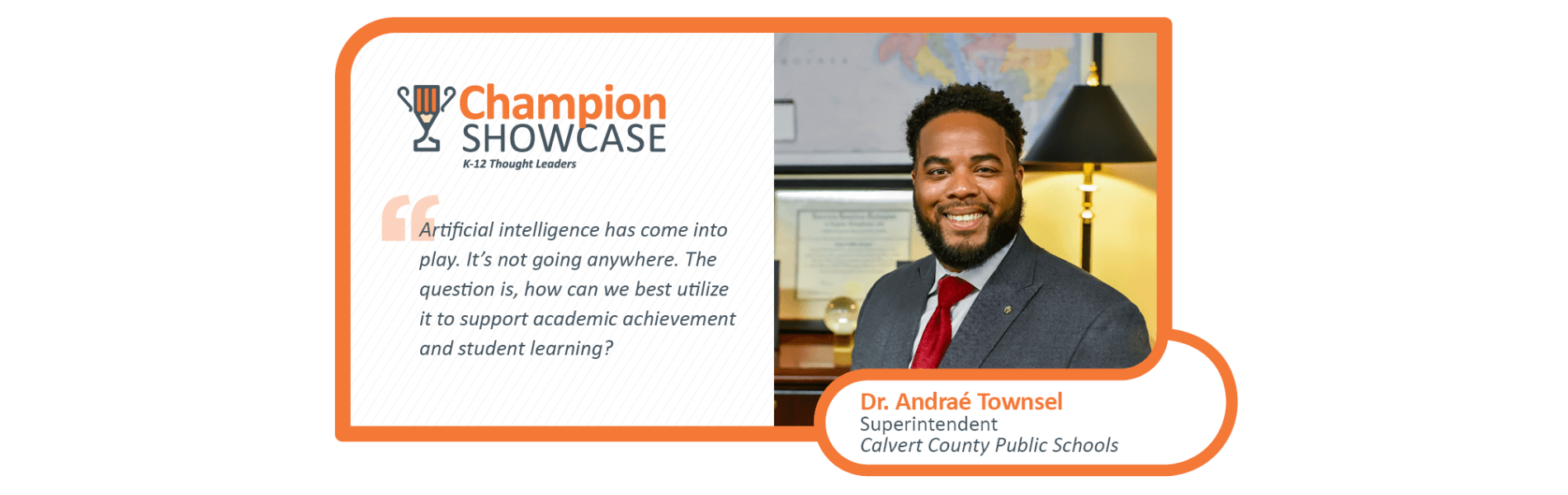
Additionally, as you know, artificial intelligence has come into play. It’s not going anywhere. The question is, how can we best utilize it to support academic achievement and student learning?
How are you approaching teacher retention and staff shortages?
I think the best way to combat the teacher shortage is to be competitive in the marketplace. One thing that I take pride and privilege in is promoting our school district as much as possible to where people often message me on social media and say, “Hey, I want to work for you.”
So, making the job look attractive. Not only having competitive pay and opportunity for growth, if you get in here with regards to career ladder, but making the job attractive. Make it look like a great place to be. Showcase your district better than other districts showcase theirs.
And I do believe that will, in small order, also attract individuals to your school district. In addition to all the teacher fairs and the online posting of vacancies, what else are you doing, above and beyond, to make people attracted to your school district?
We’re one of the fortunate school districts and we’re blessed, whereas we don’t have as many vacancies compared to our districts across the state of Maryland. All my administrative roles are filled and if we have vacancies, it’s like last minute changes right now and we have people in the wing to fill right in.
We still have some of the same challenges as other districts, but I think because we’re a desirable school district, not only with regards to student achievement, but also with regards to our human resources, we have the privilege of filling those gaps sooner than later.
How have you cultivated an environment that supports student mental health?
I was at a meeting today called the Maryland Consortium on Coordinated Community Supports.
Here in the state of Maryland, we have something called the blueprint for Maryland’s futures. There are five pillars:
1. The first pillar is early childhood education.
2. The second pillar is high-quality and diverse teachers and leaders.
3. The third pillar is college and career readiness.
4. The fourth pillar is resources for students to be successful.
5. The fifth pillar is governance and accountability.
That fourth pillar, more resources for students to be successful, has a funding source called the Maryland Consortium on Coordinated Community Supports. That consortium is designed to support young people’s mental wellness, social-emotional capacity, and behavioral health. That is a major deal in Calvert County Public Schools.
Not only did I have the privilege of meeting all of our potential partners inside the consortium, I also had our team develop something called a multi-tiered system of support (MTSS) for our school community. Our MTSS, which we developed over the course of our last academic year, focuses on all three tiers, Tier 1 support, Tier 2 support, Tier 3 support, in academics, behavior, and social and emotional learning. It’s a major driving force and hopefully we see those themes of mental health arise during our strategic planning process.
What measures are in place to ensure the safety of student athletes?
First of all, we often talk about the AAA’s: academics, athletics, and the arts. So, enhancing student experience and increasing academic achievement, but leveling up and raising the bar in those AAA’s with regards to athletics.
Right now, we’re having the opportunity to have all our high schools, we have 4 high schools, all their fields recrowned–for leveling out and fresh surface and fresh grass. Also ensuring that our coaches are up to par and all of their training requirements are met, and that our parents are engaged in the enrichment opportunity of athletics, and myself. Not only did I have a high school athletic career, I also played collegiately, so I’m trying to be forward thinking about what lies after high school with regards to athletics. What opportunities are there?
I have my class ring from high school and it’s the football helmet, it’s an offensive tackle; football, was my passport to not only a higher education, but a doctorate degree, and for me to also become a CEO, or an executive, in the field of education. If I did not play football, I don’t think I would be sitting in the seat.
I consider sport the physical reenactment of real life. That’s what sport is. It’s a physical reenactment of real life—perseverance, working hard, never giving up, doing it when you don’t feel like it, listening and following directions. It’s the physical reenactment of life. I don’t care what sport it is.
You know sport is very serious and an opportunity to teach life lessons.
Nominate a district leader we should showcase!
Is there a leader in your district or a neighboring district who is an innovator pushing their district forward? We want to showcase them! Drop their information below and we’ll do the rest.