Dr. Allisha Berendts
Champion Showcase Profile
What is your #1 concern for the school year?
In my role for Director of Student Well-Being, over the past year I’ve really focused on student well-being but specifically student mental health and increasing our services to make sure our students are getting the support that they need and that they’re able to learn to the best of their ability. I would say my biggest goal and concern for this upcoming year because I think we’ve come a long way for that, is actually our staff well-being. Our staff have really taken a hit since COVID and coming back from that, and I’m finding that we are really needing to beef up our staff well-being supports because obviously the teachers are the ones who are seeing those kids every day and needing to support them. So if the staff are not taking care of themselves, if they’re struggling with things, then they’re not going to be able to teach the kids to the best of their ability. Unfortunately, we’ve had lots of staff who’ve been struggling and we’ve had to do risk assessments or we’ve had to make referrals to outside services and things like that. I would say my biggest concern and focus for this year is continuing with the student well-being and growing that, but also what else can we do for the staff so that they can also bolster that piece too.
Can you elaborate on what you’re working toward as a goal as far as improving staff mental health?
Sure, my approach is similar to when I started in the role for student well-being. I basically started with reviewing and doing a needs assessment, figuring out what do we have that we’re offering, what’s being utilized and then where are the gaps and getting feedback. My goal really for this year is to do a needs assessment with our staff. So what are the things that you need? What do you find would be helpful not only for your own mental well-being and your own wellness, but also do you need other tools to help your students? Do you need more training in recognizing signs and symptoms of mental health conditions or suicide prevention, or is that going to make you feel more confident and more comfortable as a teacher standing in front of those students? So kind of twofold with that; doing the needs assessment to collect that information and that data, but then also gathering what at the district are we already utilizing and what tools are we using.
We have a partnership through a local hospital that does our biometric screenings and offers monthly health types of things or we have our EAP program, so learning how often are those things being utilized and do we have other services that maybe need to be put in place that aren’t being serviced that our staff would really benefit from. This year I’m going to look at it as information and data gathering so that we can then move forward into what that is going to look like in the future – what do we need to put in place making those steps to take a more educated approach toward getting your bearings straight before you continue forward.
Because just like with student well-being, we got lots of feedback and information from the students because we as adults think we know what kids need and what would help them and we can put all sorts of things in place, but if it’s things that aren’t actually going to be beneficial for them, they’re not going to use it and it’s not going to be helpful. So I want to take that same approach with staff and making sure that the things that we put in place are things that they actually will use and it’s not just like, oh, look, they’re offering another flu clinic or they’re off, whatever it might be and it’s just like, yeah, that’s not really what we need. So making sure that it is something that’s going to be utilized, it’s like a good fit for what you’re trying to do.
Do you have an idea as to how you’d like to create a better environment that supports mental health for students as well?
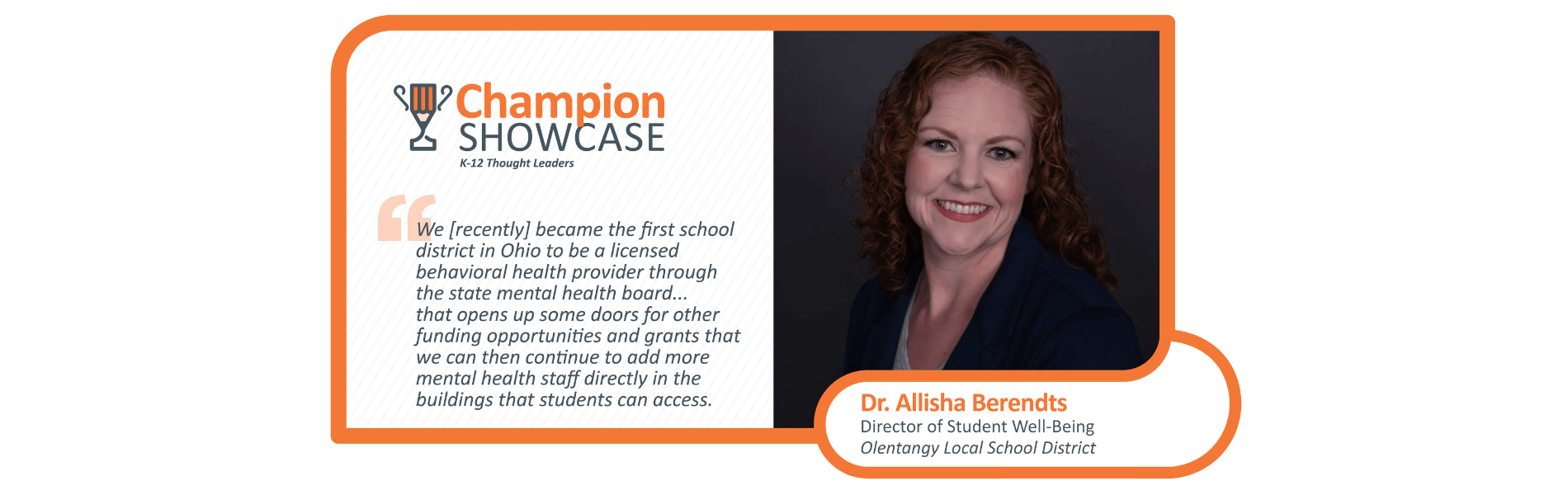
Yes, we are continuing to grow our services that we provide in school because one of the barriers that we saw were students not being able to access mental health resources outside of the school day. Wait lists are crazy long barriers to transportation, to getting to those appointments, insurance issues. And then also you’re missing a chunk of school when you have to leave, go to a doctor’s appointment and come back. You’re missing usually about 1/2 a school day. So we’ve, over the years, grown our support services that we offer in school. We actually just within the past couple months became the first school district in Ohio to be a licensed behavioral health provider through the state mental health board. And I can’t speak nationally because I haven’t been able to figure out, every state works a little bit differently with their mental health, so I don’t know if anyone else in the nation has done it, but at least in Ohio, we are the first school district to do that. So with that certification through the state, that opens up some doors for other funding opportunities and grants that we can then continue to add more mental health staff directly in the buildings that students can access. We now have staff available, clinical staff, so if students need to go and get a diagnostic assessment and have an evaluation and then have an actual treatment plan, they can have that done in school free of charge at this point. And, we have to kind of triage based on need because there’s only so many people who are doing that right now. So we can’t service all of the kids who might need it, but with this certification we’ll be able to find more opportunities to grow that staffing in the school and offer more supports.
I love how, especially talking position-to-position and district-to-district, state-to-state, it’s always interesting to see how different locations and different positions are tackling these issues that are facing us today.
What is your vision for your district in the next five years?
Well, I have lots of big plans. Ultimately, part of what this certification does, we want to be the front runner of what mental health support and wellness supports in schools can look like. We want to be able to take this certification and build programming. Olentangy is huge. We are 23,600 students and we are the size of some college campuses. So why aren’t we looking at it as a college campus where you have campus sites of counseling services, campus sites of clinics, campus sites of things like that. This is probably a five year goal I would say, but we want to look at opening an on-site community mental health agency that is run by the school but it would be run like an outpatient facility. That would be separate from the school-based services in which our students and our staff, through their insurance could access, mental health services and then that would hopefully decrease the waitlist because it would only be for students and staff of Olentangy.
We have so many kids who get outplaced for either alternative placements for education because they are struggling in the typical classroom and we do have a couple in-house ones, but even like an intense outpatient program or partial hospitalization program, being able to take the education that Olentangy is able to provide them. It would also provide that mental health support that they would have to go downtown to get at a Children’s Hospital, but on-site to be able to make sure we’re giving them the education that they expect from Olentangy, but also the mental health support that they need.
Unfortunately, the county that we’re in is a little void of services as well. There just aren’t as many resources in our county specifically so then families are having to travel anyway. We are basically our own little city. Our mental health board here calls us The Vatican.
Where do you see the role of technology in education?
Obviously technology is a huge part of our kids’ lives, probably even way more so than when I was in school, so we as educators, I think, need to figure out the ways that we are incorporating it into everyday life because that’s what the kids are used to. Figuring out how we can help educate them, be responsible digital citizens so that they know when they make their Internet footprint, that’s forever, and what does that mean and what is that going to mean when you’re, you know, 20 applying for a job or you’re trying to get into a graduate program or whatever it might mean for them. So helping them understand all of those pieces and then again for the mental health piece, utilizing that to our advantage – are there other resources with technology that we can be using? Again, because we’ll never have enough mental health staff to fully meet the need of all of our students. We’re a school system, we’re not supposed to be fully a mental health staff, but could we be leveraging more telehealth services? Could we be leveraging more apps that are helping students monitor their moods and utilize interventions more excessively in their phones? They might meet with the social worker for 10-15 minutes just to get them going on an app and then have that intervention to try throughout the week at the access of their phones. There are more and more apps that are coming out that are really beneficial for mindfulness and anxiety reduction techniques and things that kids could use when they’re stressing because their exams are coming up and they can just talk on their phone, do their little activity and then be able to be centered enough to take that test.