Chris Koster
Champion Showcase Profile
What is your number one priority right now?
We have numerous projects in the works as we move forward in Coopersville. One priority is updating our buildings to enhance safety. Solving questions like, what can we do to limit vehicular traffic up by areas where we have high density foot traffic? And how can we limit the visibility into the school from outside, but not eliminate the visibility that we have from inside to outside? To address the latter, I’ve been in contact with 3M about potential window coverings and coatings.
We’re also addressing some camera surveillance issues, primarily focusing on blind spots in some of our buildings. We’re in the process of getting those blind spots covered now.
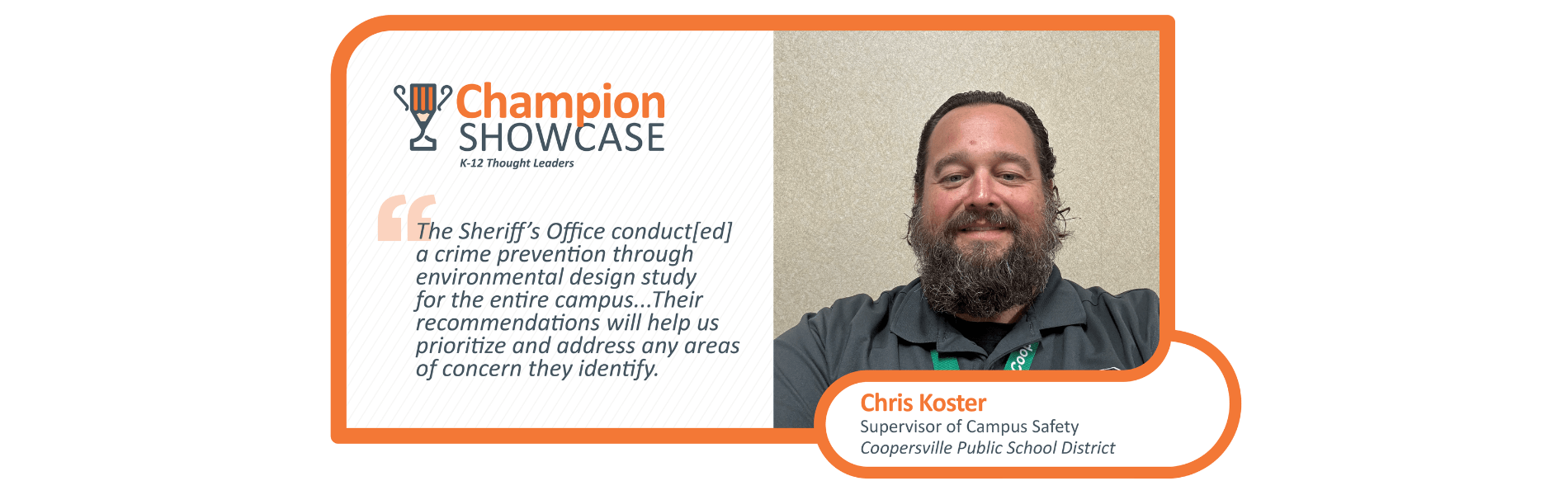
One notable initiative this month was having the Sheriff’s Office conduct a crime prevention through environmental design study for the entire campus. On July 3rd, we reviewed both the interior and exterior of our buildings. They will return for night assessments, and we conducted drone flights to get an overview for the report they will compile. Their recommendations will help us prioritize and address any areas of concern they identify.
Another student safety measurement we’re taking is installing vape detectors. We were awarded 12 vape detectors through a grant written by the Ottawa County Health Department. We’ll place eight of them in the high school and four in the middle school.
We also recently hired another school nurse for the district for better coverage. Additionally, we’re setting up the infrastructure for a district-wide radio system, aiming to have it implemented by the first part of the 24-25 school year.
The list has been endless at this point. We’re collaborating closely with the crisis team on reunification kits and have developed partnerships within the Coopersville area for off-site reunification. This is crucial since all our schools, including three elementary schools, a high school, a middle school, and our Early Childhood Development Center, are located on one campus. In the event of a major incident, we would likely need to move off-campus for reunification.
Additionally, I’ve taken on the role of district coordinator for behavioral threat assessments. I’m involved in every assessment across all buildings to ensure consistency in our approach.
I’m sure I’m missing some things, but those are some of the significant projects I’ve been working on since I started here.
What’s your vision for Coopersville’s safety over the next five years?
In five years, I hope our district will be a model for others. I envision other districts looking to us for guidance, asking about our decisions and strategies. Our goal is to become leaders in the field, setting the standard for best practices.
Where do you see the role of technology in education and safety?
While I’m not a huge technology person, I recognize its importance in school safety. We’re reevaluating our camera system and switching to a different company for better service. Our visitor management system through Raptor is another significant upgrade.
Our IT department also excels at monitoring students’ Chromebook activity for any red flags, allowing us to address potential concerns promptly. I can see us continuing to grow and enhance our use of technology since it’s such a bit part of the world and it’s only going to continue to increase in importance.
Are you having any kind of teacher retention, staff shortages and if so, how are you approaching that?
I haven’t noticed significant issues with teacher retention. We’ve had a few retirements at the end of the school year, but we’re continuously hiring and have a lot of good candidates coming in to fill these positions.
Some retirees have even returned in part-time or temporary roles to help out where needed. This shows the dedication of our staff, with many continuing to support Coops even after retirement.
How are you cultivating an environment that supports mental health?
We have many skilled social workers and psychologists who meet with students regularly to provide support. We hold quarterly assemblies for high school students and meetings for middle schoolers focused on mental health, promoting programs like “See Something, Say Something” and “OK to Say.”
Our SRO also conducts presentations on cyberbullying. We’re committed to emphasizing mental health, ensuring students know they have people to talk to if they’re struggling, and that we’ll get them the help they need, either in-house or through referrals.
What measures are in place to ensure the safety of student athletes?
In my short tenure, I haven’t fully delved into the aspect of after-school activities and their safety protocols. However, I recognize the importance of safety during these events. For home football games, we contract with the Sheriff’s Office for on-site patrols. This fall, I plan to attend football games, except when my son has water polo matches, ensuring a strong presence. For home basketball games, I also plan to attend, and we’re considering contracting with the Sheriff’s Office again to maintain safety and address any issues that might arise.
What advice would you give other districts?
I would say to come in humbly. I gained numerous experiences and a lot of knowledge in my prior career in law enforcement, but I don’t know everything about schools. For a couple of years, I was the weed and seed community policing officer, so I had contact with schools, but not to the extent that I have now. Bring the knowledge base you have, but it’s crucial to talk to your staff and students to understand their thoughts and concerns about safety. Address these concerns and move forward accordingly. A good starting point for student interaction is through your student government, as it’s a small enough group, and then expand from there if possible.