Chip Jones
Champion Showcase Profile
What is your #1 concern for this school year?
Teacher recruitment is our top concern for this school year. And that also ties into staff turnover and retention. We try to have a good work environment and collaborative culture, where people have opportunities for professional learning and we keep class sizes respectful. We try to offer a competitive benefit package with the surrounding areas because I know money isn’t everything, but you do have to have it to live, and that also includes health insurance benefits. We make sure we have modern technology for staff members to use, networking opportunities for staff to know each other, and we are also a family-friendly calendar. We have an August start date and get out mid May. We also have opportunities if staff members want to earn extra money teaching before or after school.
It gets tough because we are a small, rural school division that does not have a lot of business and industries, so we have to make sure that we connect with different community partners and different business partners to ensure our staff and students have access to opportunities. It’s a bit of a juggling act at times. This year we partnered with Longwood University in Farmville, Virginia and 15 of our staff are getting their masters in reading or their endorsement and we are covering the cost of their classes and some of the cost of their books. We look into grant funds to cover some of that and you always have to be thinking.
Where do you see the role of technology in education?
Technology has a huge role in education. It’s a resource. And when you think technology, you also think of internet as well. I was just saying that internet connectivity is just as important as food, water, and shelter because so much of the world is through technology and internet access. But technology, especially in a rural school division, allows you to be able to connect and see other things that are taking place outside of Cumberland county. It could be seeing pyramids or weather patterns while working on a research project. Technology is also only going to be as good as the teacher using it which is one reason I have to have the best teacher I can in front of the classroom.
One of the things we did this year, is our virtual reality lab. There’s a lot of school divisions that have them. I went to a presentation at Virigina Tech and met a superintendent there who, at the time, was from Bristol City and he talked about their virtual reality lab. I didn’t know much about it, but I knew we needed one. So I came back and talked to our technology lead and some of his students. One of the students said he would be willing to do his senior project on creating a virtual reality lab for us. So the technology lead, two students, and myself went to Bristol to meet with their technology team. And on the trip back, we discussed that the students would create a business plan and present it to our central office. They did the research about the monitors, the TVs, the size of the room. They did a presentation with the estimated cost. It went through the approval process and was approved. They worked with the finance office on the ordering, they built the computers, they worked with the Cumberland County maintenance team on where monitors needed to be hung, and that student-led and student-built project opened this year.
We are a long, narrow county on Route 60, and bordered by a lot of counties that have a lot of business and other tax base other than local taxes. At a superintendent’s meeting one time at a community college, they were talking about Mecklenburg County, how they have the Microsoft data centers and it’s brought in a lot of jobs and revenue to the county. They were talking about how Mecklenburg schools and Microsoft and the community college had all partnered together to create these mock data centers where students could go get certified and earn different credentials so that when they graduate from high school, they could go work for Microsoft. So after this meeting, I went to the college president and some of their vice presidents and asked how Cumberland could be part of this. We’re about an hour and 45 minutes from that area, but I said my kids need that opportunity just like everyone else. How do we make that happen? They had a National Science Foundation grant, and through a partnership, our students videoed into the course Monday-Thursday. We agreed to transport them an hour and 45 minutes one way to the class for a hands-on piece, and 3 of the 4 students earned their certifications. It worked very well so we’ve continued it this year. Three of the students have gone on to college to work on their computer science degrees and one went into military and wants to join Air Force to work on planes, so that’s good. Now we have 6 students enrolled in this same program.
What is your vision for the district in the next five years?
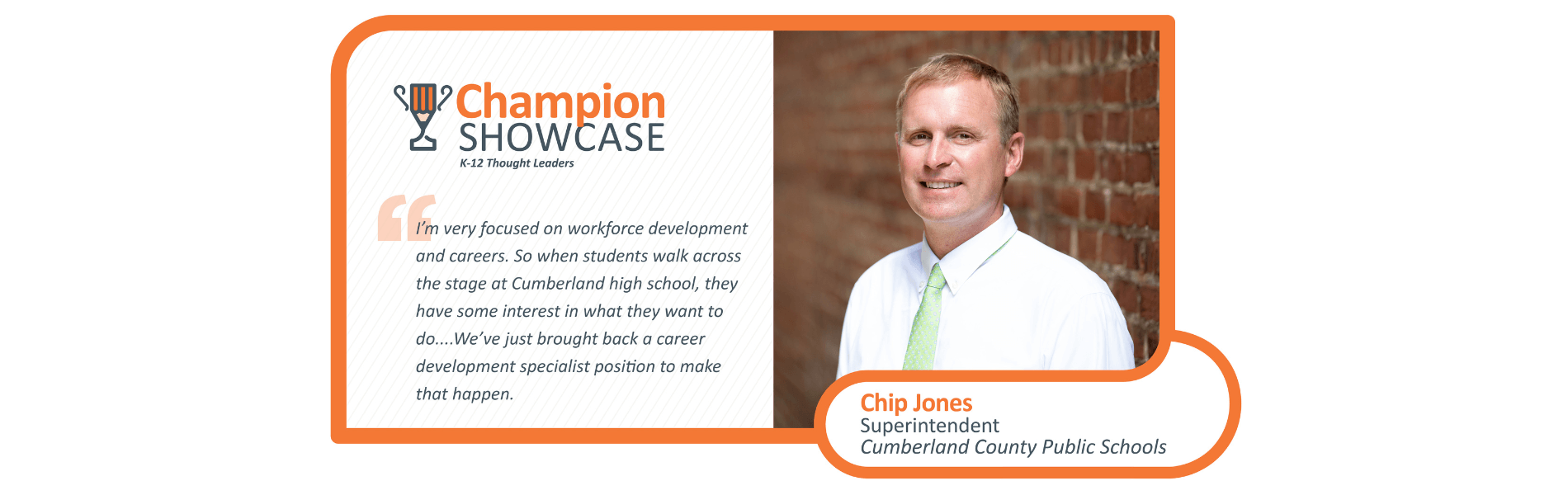
I’m in my 20th year in Cumberland schools. I’m in my fourth year as the superintendent. I’m seeing a lot of progress. The superintendent that retired, Amy Griffin, was very progressive and I had the privilege of always being her assistant in various roles. But my vision for Cumberland for the next five years, I’m very focused on workforce development and careers. So when students walk across the stage at Cumberland high school, they have some interest in what they want to do. Whether it’s go to a four year school, go to a community college to get an associates degree to move on to a four year school or to get a certification, or they need to have portable credentials here where they can go into the workforce and work. That every student here, we’ve given them experiences where they’ve explored different careers through an internship, an externship, or job shadowing – or even someone coming in and talking about careers. We’ve just brought back a career development specialist position to make that happen. I want students to be able to write well. I want students to read hopefully at grade level and be able to do math, and for students to have those basic skills. Some people think this is odd, but I think everyone needs to know how to swim. We’ve partnered with the local YMCA where second graders take swim lessons. I want students to have the skills to take care of themselves and be a productive citizen in society.
As far as the division, just building the capacity that our teachers are always growing because if our teachers are growing and learning that impacts instruction. If we reach a goal, we need to be thinking “what’s next” and not become complacent. That we are always searching for different funding and revenue sources to bring opportunities and the next thing for our students. We want to make sure we’re exceeding minimum standards. I think sometimes we get into a standardized testing mindset that we’re just chasing the minimum, but rather how do we reach the minimum and then go above.
How do you cultivate an environment that supports mental health for your students?
We do a good job of that because we are a small rural school division and that has its pros and sometimes its cons. I’ve never worked in a big school division, but we know individuals here because the grade levels have about 100 students each. We have staff that have been here for a while so they know families. It’s easy for our students to have access to an adult, whether it’s their administrator, someone from the central office, me, a school resource officer or so forth so if we see a student who isn’t having a good day, usually there is some follow up from an adult, maybe even a phone call home asking what’s going on. With our school counselors, we have a partnership with their local community service board so students who may need a little more counseling than what we can provide in school, there is a counselor here on site so students can attend their session with their counselor without leaving school and getting into attendance issues. So there’s a lot of adult interaction. When we find out a student is struggling in certain areas, we come together to put a plan in place and look into community resources. So I think where we might not have all the resources that bigger divisions have with different partners, we do have that human connection where kids are seen as individuals and we’re able to make the connections to get them the support they need to the best of our abilities.
What I’ve seen is that new team members who have come here from bigger divisions, or have left here and gone somewhere else, they say it’s more like a family here. Whether it’s a student or adult member that’s struggling, someone is checking in to offer support. We’re visible, we’re approachable. This morning I did bus duty and spoke to every kid who got off the bus. You make those connections and when a kid is struggling they’re more likely to come to you, or you’re more likely to approach them. That’s why I think it’s so important to have school resource officers. For the safety, but it also helps makes a connection between the student and law enforcement and they see that partnership in a different way than some of the horrible things they may see on the news.
Nominate a district leader we should showcase!
Is there a leader in your district or a neighboring district who is an innovator pushing their district forward? We want to showcase them! Drop their information below and we’ll do the rest.