Barbara Malkas
Champion Showcase Profile
What is your number one concern for the 2023-2024 school year?
Number one for me is looking at academic growth that students really need to recover from the outcomes from the pandemic. We’ve learned that academic growth is not isolated to instruction or instructional methodology, but it was more about relationships, social skills, and the physiological impacts of isolation. In collaboration with that, the equity issue is now being evaluated.
Data is telling us that students need academic progress, but that progress can’t be in a vacuum and requires a reintegration into the school community. Some students flourished in the pandemic and learn great independently but others really languished without that social interaction, and need more in terms of relationship building, connection, and engagement to close academic gaps. In the absence of a community like public education, it can have a profound impact on our health.
What is your vision for the district in the next 5 years?
Focusing on top 3 strategic objectives: instructional prioritization and engagement, social and emotional health and well-being, as well as looking at the district and our practices through an equity lens. We’ve made gains in the last two years, this past year especially having a full year without disruptions, but it’s going to take longer to recover than the pandemic itself.
Are you dealing with staff shortages?
Being in a small municipality surrounded by rural communities, we’re isolated from big economic urban centers, so the shortage is impacting all of us. A teacher I’ve trained goes to a district next door, and then I’m recruiting from another district to fill that position. We keep seeing this wave of teachers who will come into a high needs district like mine to get the training they need and then be recruited to my more affluent neighbors next door, and they’re getting a very highly trained educator who has a wealth of experience working with a more challenging population. Then, I’m in a situation where I have to go find and hire folks who may have less experience coming into the profession.
Challenges in other districts may appear to be less. I don’t think the grass is greener, but I think what people have learned through the pandemic is that they at least want to try to see if it’s greener on the other side, and so we’re seeing a lot more movement.
There were also people who wanted to retire and districts are seeing a lot more early retirement. There are feelings of vulnerability that factor into that – wearing a mask, how wearing a mask impacts how they teach and relate to their students, health concerns of their own or for their family, and they feel that they’re fine to leave a few percentage points on the table and enter retirement early. It’s a very personal decision. There’s also no such thing as substitutes anymore. And it’s unfortunate because that might be the way we brought someone into the teaching profession.
How do you see student-athlete safety being addressed?
We’ve actually had a law in place since around 2012 requiring us to have AEDs in areas around athletic participation and a mobile AED at all games and practices. The problem was not investing in the equipment. The bigger issue was getting rudimentary training, so everyone felt comfortable using and initiating use of the AED.
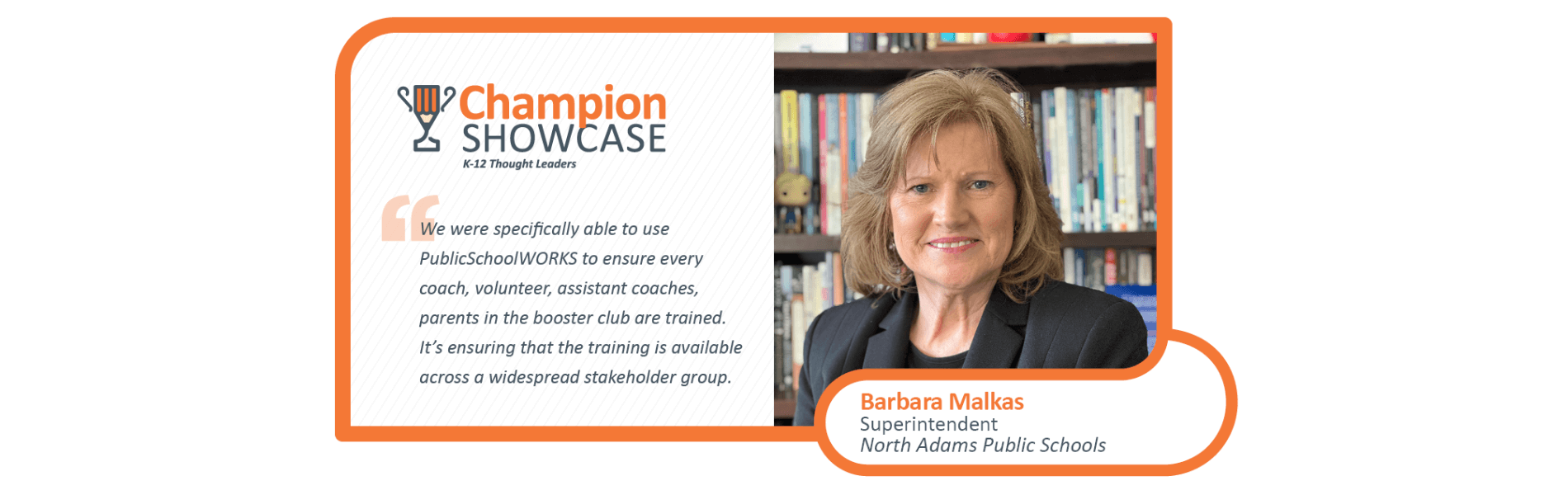
We were specifically able to use PublicSchoolWORKS to ensure every coach, volunteer, assistant coaches, parents in the booster club are trained. It’s ensuring that the training is available across a widespread stakeholder group. None of us are perfect and remember everything, but someone will remember something from that training and people can support each other with what they remember in implementing, and that’s what must happen.
We recognize that long-held, traditional sports can be dangerous. We’ve known that for years. But as we see our student athletes wanting to emulate their professional athlete heroes, it can be even rougher. A student athlete can go through medical evaluation and be cleared to play, but factors like dehydration, heat exhaustion, and heart conditions can be a huge factor. We want to empower student athletes to also advocate for themselves and their own well-being to clue us in. Like when professional gymnast Simone Biles said, “I don’t feel safe.” Every student should have the right to say that to a coach, no matter the level the game of play is, and have that self-advocacy. I think we need to do a better job to encourage and train our athletes to understand their own health and then be good advocates for their health and well-being.
Mental health is part of health and destigmatizing the idea that mental health is a sign of weakness. It actually takes incredible courage to acknowledge that your mental health requires you to take a step back because it will impact your physical performance and ultimately lead to physical injury.
Final Thoughts
Thank you for being a good partner in education. When our district used to do compliance training in-person, it was a full day as people were coming back from summer vacation, and we found that they remembered nothing. I sent veteran educators to serve on a focus group with a state audit process, and when asked about compliance training, no one could recall being trained. We had sign in sheets proving their attendance, and they could not remember anything. It was so traumatic they had blocked it out! Since we brought on PublicSchoolWORKS, we’ve been able to work with our safety advisor, Angela, to ensure we’re doing the correct amount of training we need to, but not anything in excess. We can open the training window early and let staff start when they want; we’re not waiting for that one day of lethal training.
Nominate a district leader we should showcase!
Is there a leader in your district or a neighboring district who is an innovator pushing their district forward? We want to showcase them! Drop their information below and we’ll do the rest.