10 Facts About Equity in Education for Black Students
Blogs

Equity in education is crucial because it ensures that every student, regardless of their background or circumstances, has an equal opportunity to succeed and reach their full potential. Equity is a system in which resources are distributed according to need. Equity considers a person’s starting point and what each person has in order to determine what they need, which allows resources to be allocated in a fair way.
Creating an equitable educational system that cares for every student based on their individual needs and designs their education experience according to those needs is paramount to a student’s success.
Each student should have the opportunity to be supported and be provided the resource they need to achieve academic and social goals regardless factors such as gender, race, learning ability, economic climate, or physical disability. In this blog we’ll focus on the current state of equity in education for black students. Below are ten facts that address critical issues facing black students in the United States today.
1. Black Students Receive Disproportionately Higher Disciplinary Actions
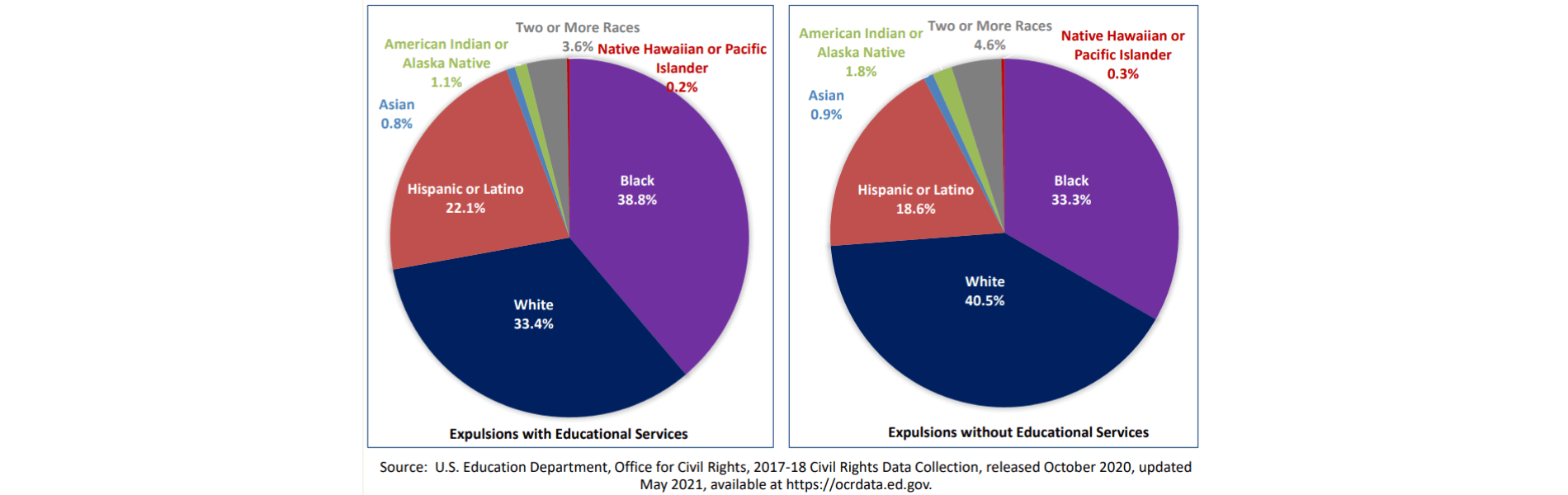
According to the CRDC (Civil Rights Data Collection), in 2017-2018, “black students, who accounted for 15.1% of total student enrollment, were expelled at rates that were more than twice their share of total student enrollment—38.8% of expulsions with educational services and 33.3% of expulsions without educational services.”
2. Poverty Affects Black Students at a Higher Rate
In 2018, nearly one third of Black students lived in poverty (32%), compared with 10% of white students in families living in poverty. The percentage of Black students who lived in households where the highest level of education attained by either parent was a bachelor’s or higher degree was 27%, compared with 69% of Asian students and 53% of white students.
3. College Enrollment Rates Among Black Young Adults Are Trending Upward
From 2000 to 2018, college enrollment rates among 18- to 24-year-olds increased for those who were Black (from 31% to 37%). Among Black males, college enrollment rates were higher in 2018 (33%) than in 2000 (25%). However, among Black females, the rate in 2018 was not measurably different from the rate in 2000.
4. The Achievement Gap Between White and Black Students Has Narrowed
The long-term trend shows that the achievement gap between Black and white students has narrowed. However, the progress is minimal, and the gap is still there. The National Report Card (NAEP) shows that from 1992 through 2019, the average reading and math scores for Black 4th, 8th, and 12th graders had always been lower than those of their white peers.
- Only 9 out of 100 Black students performed at or above the NAEP proficient level in civics.
- Only 13 out of 100 Black students performed at or above the NAEP proficient level in math.
- Only 15 out of 100 Black students performed at or above the NAEP proficient level in reading.
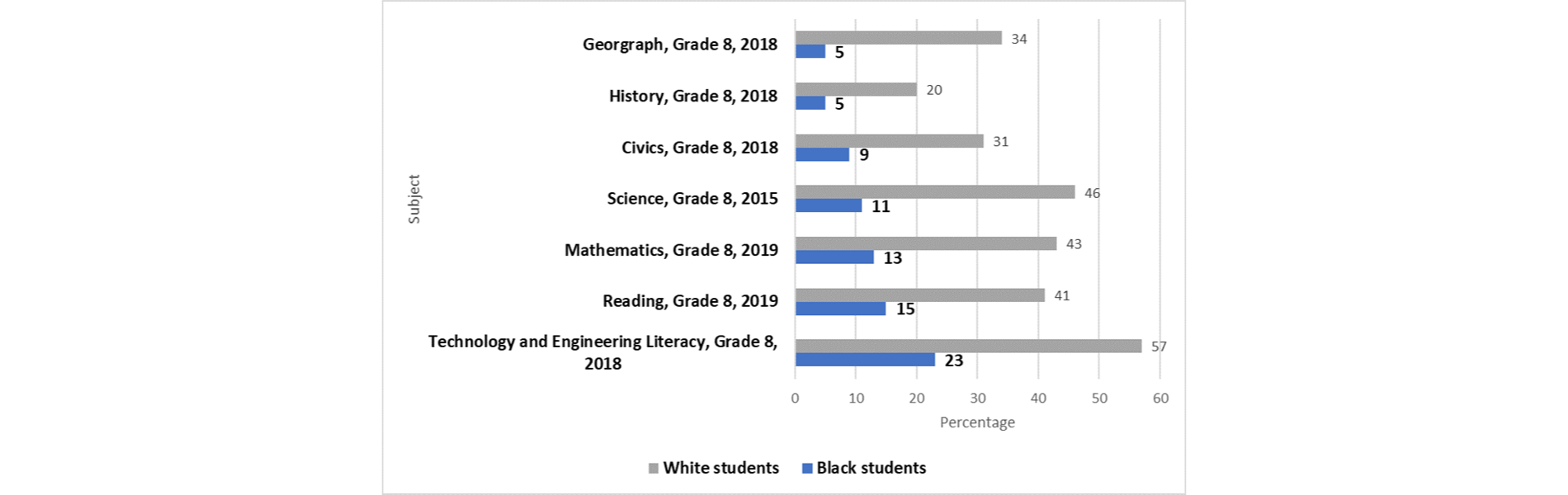
Figure 3. Percentage of 8th grade students who performed at or above the Proficient, by subjects, Black vs. white students
Source: https://nces.ed.gov/nationsreportcard/?src=ft
5. Blacks Are Still Underrepresented in Education Professions
According to the 2019 EdWeek article, 6.1% of teachers were black and 10.4% of principals were black, as compared to 13.6% of the general population and 15% of K-12 students.
6. The Equity Action Plan Was Released in 2020
In 2020, the U.S. Department of Education released its inaugural equity action plan which is a commitment to advancing racial equity and support for underserved communities.
7. Black High School Graduation Rates Are On Par With National Average
In 2022, some 95 percent of 25- to 29-year-olds who were Black had completed at least high school.

8. Black Students With Black Role Models Have Better Academic Success
Black students who were randomly matched to Black teachers did, in fact, have better long-run outcomes. Black students who were exposed to Black teachers by third grade were 13% more likely to enroll in college. If kids had two Black teachers by third grade, Hart said, the likelihood of college enrollment jumped to 32%. Hart and her colleagues call this the role-model effect.
9. Discrimination in Schools is Still a Top Concern Among Blacks
According to UCLA’s The Civil Rights Project, Black Segregation Matters: School Resegregation and Black Educational Opportunity, in its September 2020 annual survey on education, Kappan Magazine reported a national survey showing that 79% of Blacks saw education as a highly important issue, with 46% of them viewing it as “extremely important.” Ninety percent of Blacks, compared to 62% of Whites, believed that government should increase its focus on “protecting students from discrimination in their schools.” Only a fourth of Blacks, for example, support test-based admissions to special programs that lower Black and Latino access.
10. Education Funding is Inconsistent Across States
According to The Education Trust’s 2018 Survey, per pupil spending is inconsistent. “There is, of course, great variation among states’ school funding patterns. Nebraska stands out for its unfairness, spending nearly 25 percent less per pupil in districts serving the most students of color. And while in fourteen states, districts that serve the most students of color receive substantially more money, in 14 other states, they receive substantially less.”
By advocating for equity in education, we create a level playing field where talent and hard work are the primary factors of success, rather than socioeconomic factors. When all students have equal access to resources, support, and opportunities, they are more likely to thrive academically and pursue higher education or rewarding careers.
Every individual, regardless of their circumstances, deserves an education that equips them with the knowledge and skills necessary to lead fulfilling lives and contribute meaningfully to their communities.
K-12 education, as well as higher education, should continue to be held accountable for providing a safe and equitable environment for learning as we as advocating and fostering student development. Continually assessing and measuring progress is necessary to support equity.