Lawrence Fernandez
Champion Showcase Profile
What is your number one concern for Madera for this school year?
My number one concern, not so much for the school year, but in general, is overall student safety. We accept people’s children, and in my opinion, those are their crown jewels, that’s their treasure chest, that’s what they live for. Here in Madera, I take that very seriously because I send my kids off to school with the hope that they’re going to be safe. What I think about not only this year, but what I think about every year is student safety.
How do we protect the precious jewels of our community and of our parents? What I try to do here in Madera is put a program together that ensures the best possible safety I could get for those students.
It’s sort of a balancing act. For instance, a lot of our schools at one time were very open and I love that concept, I really do. But we’ve made it to where you’re forcing people to go through the front office to appear on camera and we have mechanisms in place to ensure they go through the office. We may talk about those things; we have so many different things going on as far as safety is concerned, but we force people to go into the front office and that has helped because our schools were built years ago for people to walk in through any number of entrances. I get it, but nowadays we don’t want that per se.
Some of the systems we have in place include extensive campus cameras and a wall of monitors, which enables real-time monitoring and dispatching of our SRO’s, and external door button-activated maglocks. On top of that, about seven years ago, I attended a training given by Lieutenant Colonel Grossman in the Bay area which led to adding protective coating to our schools. We have strategically placed the protective coating on several of your buildings. We are just not making that placement available to the public.
What we’re working on right now is a network sharing system where our local law enforcement will be able access our camera network instantaneously and know exactly where the bad guys are.
What other forms of technology will play a part in your team’s continued preparation of the campus to be safer and more resilient, to keep students safe?
Let me back up and let me tell you this real quick. One of the things that is not even technology, but I’ll tell you that’s been the most valuable to us is building relationships. This morning when we were greeting kids, ‘Good morning, good morning. How are you?’
When they build that trust, in an adult, they will come to them, when they need help. Whether that’s abuse at home, whether that’s violence on campus, whether that’s drug dealing, whatever that may be, they can go to you and report that, because they trust them.
But now going back to technology, what we have at the front office is a visitor management system. On top of that, once we have students walk on campus, we have an anonymous reporting app. Now in Madera we have about 22,000 students in our district, and we have 6,000 downloads.
We just made a new video, and our goal is 7,000 downloads. It’s not available for kindergarten through third grade. Over a third of our population is on that app and we’ve stopped suicide attempts, we’ve stopped weapons, we’ve stop drug use and sells.
Kids want to report, but they want to do it anonymously. We even have parents reporting. Another thing that we did was encode it on all our school computers. A lot of our kids live in a very impoverished area, and a lot of our kids don’t have money for a cell phone. We give laptops to our kids. It’s on every computer in our school and they have their own to take home. They can report on campus, in their classroom, whatever it is that they want to report anonymously.
We just introduced a weapons detection system. Our kids will walk through two panels, which leverage AI with a magnetic field. It detects large knives and guns, and that’s what we want to force off our campus. We used it last Spring at graduation with great success and have implemented it in nine schools. It’s been a great deterrent to keep weapons off the campus.
Can you elaborate on some of the other things you guys do to promote strong mental health?
One of the things that I train my staff to do, and I model it, is when I’m walking on campus I’ll try to say as many ‘good mornings’ as I can, shake hands and see how they’re doing. Let me give you an example, one day I was walking by this gentleman, and he looked new to that campus.
That’s the other thing, don’t isolate yourself in your office, get out and interact with kids. So, I was walking to the yard and believe it or not I walked by, and I said, “good morning.” He looked at me and cursed. I told him, “Wow, okay, well have a great day.” I went back the next day, and we had the same exact interaction. After a few weeks passed, I sought him out to say “good morning” again, and again he swore at me. I found him again the next day and said, “listen, if I’ve done anything to you, please tell me because that was not my intent. I was just saying good morning.”
He apologized and said “I lost my mom and I’m hurting. I’m mad at the world, and you were the one that said ‘good morning’ and it wasn’t a good morning.” We talked for a while, and I was able to connect him with a grief counselor. My SRO’s take the same approach and come to me with similar stories and really prioritize building relationships with our students.
I also have a program that we created with the prison, called the Re-Direct. We take a group of at-risk kids to the prison, and we show them the yard and we pair them with a well-trained inmate. Basically, they sit down with that child and tell them, listen, I’m not going to scare you. I’m going to tell you about my life. I’m here for the rest of my life. Please don’t do that to yourself.
And our students will share with them. These are very at-risk students we’ll share with them. Then we’re able to get that information, triage, bring them back and get them the support that they need.
There was this one student that we took to Re-Direct. His father was in prison, and when he was released from prison, he died a short time later from cancer. This student was upset. He hated the world. I started working with him and started mentoring him. He’s now at college, playing college ball. He got a scholarship. These are the things that we’re talking about – things to make your campuses safe. Don’t get me wrong, I love technology. It’s a great thing for us, but it’s good old-fashioned relationship building that changes lives.
Switching gears to the safety of student athletes, is that something that in any way falls on you and your team?
We just hired a great guy as a supervisor to help me. He’s an 18-year veteran in law enforcement who loves kids and loves schools. He transitioned over from his life as a cop to help me protect our kids. One of the things that we notice is that in case of emergencies, we were underprepared.
Let’s say it’s football. You have an injury where a kid gets hurt, and you have a compound fracture. We could get into our medical bags, and in our medical bags in here we have multiple different things, and one of the things I can pull is a tourniquet. All our safety officers are trained in Stop the Bleed.
All our schools, our high schools have about 5 medical bags. These can treat seven major incidents, major wounds—collapsed lung, gunshots, etc.—and about 21 minor injuries. We trained them every year in Stop the Bleed, and it’s repetitive because we want it to become second nature.
What we did was collaborate with our first responders, our paramedics and we came together and said “what would be needed for these medical bags? What would you have if ideally you could have it?” and this is what they said. That’s what we put in here. These are in our patrol units, our safety units, officers carry their tourniquet on them.
Do you have a vision for three, four to five years down the road where you are, what you and your team have implemented or where what, what you might be seeing out there that you need to tackle in the future?
One of the things that we are tackling right now is that some students, whether it be high school age or all the way down to 3rd grade, have suffered severe trauma in their life. Whether that’s violence in the house, abuse, whatever that looks like. And sometimes our kids come to school and they’re unregulated.
We have kids that are breaking down. We have kids that are explosive again due to their trauma. So, what we’re going to be introducing here very soon is the hiring of three elementary leads which are going to patrol our elementary school; but guess what they’re going to have with them? A therapy dog.
Our dogs are going to walk on our campus first thing in the morning, and students are going to be greeted with “Good morning. How are you?” They’re going to be petting the dog and they’re already starting their day off with what a giant smile.
We’re also going to incorporate it in student awards. When a child performs an act of kindness or an act of bravery or steps in where a kid is being bullied, we’re going to have a stuffed animal replica of the dogs that we present the student with as their award, and we’ll do it in front of all the kids in a ceremony-type setting.
We’re looking at bringing three therapy dogs with our safety officers that are going to be trained. And then we’re going to put them out in our community so they can visit our schools and they can basically change the climate in schools.
But also, if a kid is on a desk throwing objects around whatever, maybe we bring in that dog, he has a relationship with that dog, he steps down. Dogs do some amazing things. That’s what we want to do, and we hope to introduce that this year.
One of the other things that we’re looking at in the future, is we have a probation officer that we hired to work with us and be proactive with our kids. Again, I want our kids to see our SRO’s, our police officers, our probation officer, as benefactors—somebody that’s there to support them.
We’re going to send out a drug detection dog, and it’s going to be a law enforcement trained dog that’s going to be trained in weapons detection and drug detection. We have a lot of vape pens with THC on our campuses that’s wreaking havoc on our kids – social, emotional, depression, anxiety, the addiction qualities.
We want to have a drug detection dog that we can take to any of our campuses and deter drugs from it, so kids know that we’re going to be able to detect them and they’re not going to bring them on campus. We’re hoping to get that in place this year and for something that we see in the future.
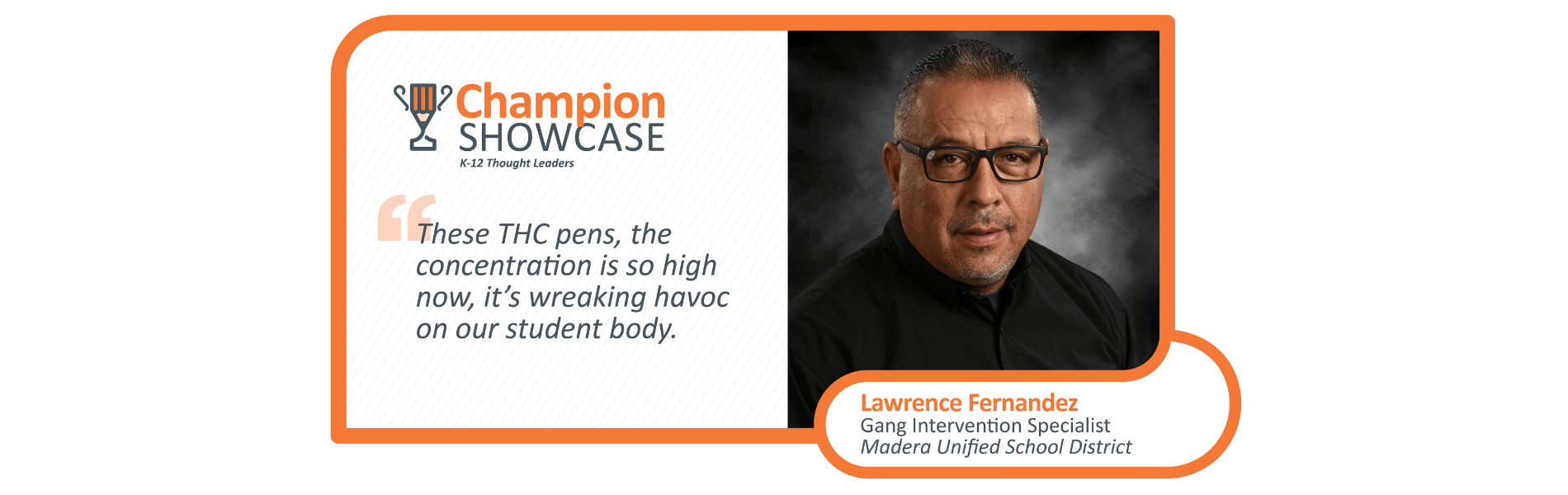
The thing is that these THC pens, the concentration is so high now, it’s wreaking havoc on our student body. And I believe it’s highly addictive, because we see kids, so many of them that are smoking before they come to school, during school, and after school.
Like I mentioned earlier, we basically had to say how we’re going to address this problem and what we want to do is not catch but deter. We want kids to know that they’re going to be caught if they bring it to school, so let’s deter them from ever bringing to campus. At least we get 8 hours of them not doing any type of substance abuse and then we can deter off campus.