Amy Mount
Champion Showcase Profile
What is your number one concern for the 2023-2024 school year?
Our biggest concern is ongoing recovery from COVID. Specifically for this year, how we meet kids and teachers and families where they are and still drive forward and improve education and improve educational outcomes for everybody.
I’m happy that there’s less conversation now about learning loss. I think learning loss was a misnomer. Kids were still learning at home. It’s maybe not all the things that we would have wanted them to learn, but the idea that kids were behind is an artificial construct anyway. We determine where those benchmarks are.
After the disruption of COVID, sure, we had things we needed to make up for educationally, but more importantly, making sure that kids were OK, and families were OK, and that teachers were OK, and that we feel safe and comfortable and ready to learn together.
Now that we’re back, we’ve had a full year back in the classroom where we’re ready to get back to routine. We’re ready to start launching forward again and really making some real progress. I know there was a big push for learning acceleration right when we came back. We really needed to address some more of those lower levels of Maslow’s. You have to meet those Maslow’s before you can Bloom. Last year was making sure that everybody’s Maslow’s needs were met so that we can really push forward in that learning and reach those upper tiers of Bloom now.
Where do you see the role of technology in education?
There’s tremendous benefit to ways that we can leverage it. One of the biggest Silver Linings from the pandemic was finding all of the ways to leverage those technology pieces that we had no choice, that we had to use in COVID, and now how can we pull those forward. Prior to the pandemic, this conversation with you probably would have been a phone call. Now video conferencing and the ability to do that is just second nature and we do that.
I am in a unique position in that I serve five legally separate distinct school districts. We are five separate school districts, one school district, very small, but we all operate together as a pre-K-12. None of the towns touch each other in terms of geography. We’re spread across these four different towns. But through technology we’re able to collaborate. We do a lot of our cross-town meetings, that would have required time and travel, on Zoom now. We started that in the pandemic and now we’ve continued.
We’re still offering parent meetings on Zoom because it’s so much easier for our parents to be able to jump on during their lunch hour or during a break, to do those things. It’s really helped facilitate connections.
It really took a lot of those old pen and paper and textbook things that we used to do and we’ve really thought about how we can transform them. We do see a lot of kids who still want the poster paper. We haven’t transformed everything over to technology because sometimes you just need a marker in your hand, and crayons in your hand, and you need that tactile stuff. But it’s nice to be able to have this really good balance and I think that the role of technology now is really in helping us find those tools.
We’re also doing a lot of professional development online. PublicSchoolWORKS has been fantastic for us to meet those professional development requirements and find ways that we can leverage time and support and flexibility that teachers need to complete these compliance trainings.
We’re also partnering with other professional development providers so that we can really customize professional development for teachers just in time, right where they are, they can access it 24/7. I don’t have to shut down all the schools for a day for a PD, bring in a presenter, pay people to drive across town and all that. We can access things when we need them, where we need them, wherever they are.
How are you guys approaching teacher retention or staff shortages?
We are incredibly blessed that we have not had a lot of issues with retention and keeping teachers here. Most of our teachers stay. We have not lost a lot of teachers and I really attribute that to overall leadership approaches across all our campuses that we really center on adult wellness. Our goal as leadership is to take care of the teachers so that the teachers can take care of the kids.
We have had some teachers who have left either for retirement or to try things other than teaching, but we have not seen the issues that most other districts around us and around the country have had. We’ve been very, very blessed. We have amazing teachers.
When we have had a few openings here and there, we are incredibly blessed that our teachers find and recruit their friends and bring them on board. We have a really good working culture across all five of our schools and we’re very, very proud of that.
It’s something that we spend a lot of time talking about. How can we make this not just a great place for kids to learn, but how can we make this a great place for the adults to learn together and work together? We all have to live here and love each other and function as a family.
How is Gateway Regional cultivating an environment that supports mental health for students or staff?
I’m really proud of you know we have some cutting-edge things that we’re doing here. Again, we are really small districts. Gateway Regional is a 7th through 12th grade building.
We have about 865 kids enrolled, but we have 5 full-time guidance counselors, a full-time substance abuse coordinator, a full-time crisis counselor, and a full-time mental health coordinator—who helps really make sure that kids are serviced here, that families are serviced here, that we’re able to connect them with resources in the community.
At each of the elementary campuses we also have counselors and social workers, and we work together across all 5 campuses to help families connect in the community. Mental health is a big part of it.
Across all five of our schools, we do also have morning meetings. It’s a time when all the kids come in together, they spend the first 20-ish minutes of their day in a safe supportive environment. Kids are hand selected to be put together with a teacher who can really guide that.
Even at the high school we spend those first 20 minutes, we sort of re-envisioned the way that we do our homeroom, so it’s not just about watch the morning announcements and get these papers passed out. We spend 20 minutes every day on ‘How what are you doing?’ ‘How can we learn together?’ ‘How can we build community every single day?’ And those kids stay together for the majority of their career here at Gateway because we really work on building communities so that they have a safe place where they can come in every day now.
You know, that’s a space where kids know every day this person, this adult in the building, is here just to make sure that I’m OK, to check on me, if I’m not here they notice. I’m not just another seat in a class. I’m an individual in this place. You know, really working on making sure that we’re building that community first every day.
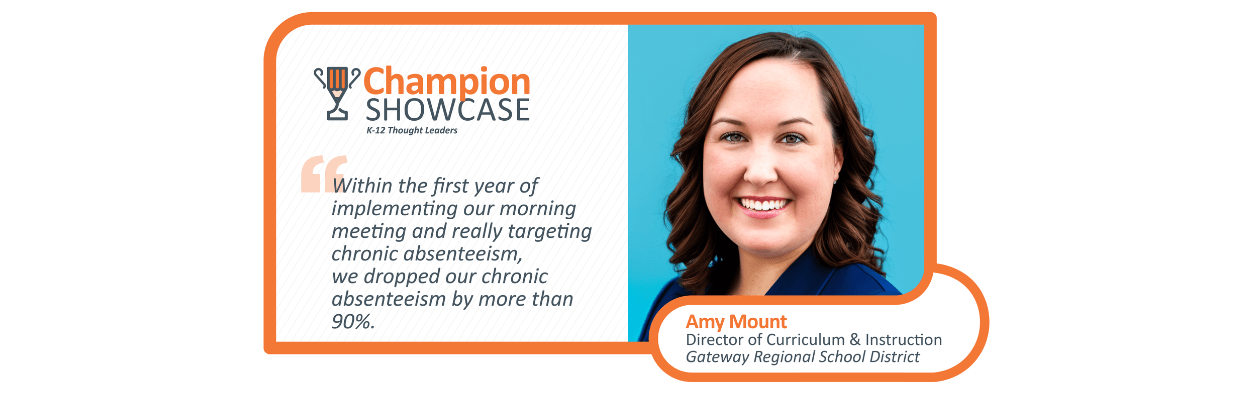
We find morning meetings to be really effective. It gets kids here and it really has cut down chronic absenteeism. Prior to COVID, we had some pretty significant concerns with chronic absenteeism. Within the first year of implementing our morning meeting and really targeting chronic absenteeism, we dropped our chronic absenteeism by more than 90%.
For teachers, our motto during COVID was grace and space. We try to really build in as much choice and agency for teachers as we build in choice and agency for kids. Our teachers have access to our guidance counselors and to our mental health coordinators. They run professional development sessions for teachers. Every year, we do an entire professional development day in the spring that focuses on teacher voice and choice and agency.
We do some of those sessions on education and learning from each other, but we do some of those sessions on taking care of ourselves. There are always several people who do yoga sessions. We played pickleball in the spring. We painted together. We really try to honor the individual, whether that’s the teacher or the kid.
What is your vision for your district in the next five years?
My vision for our district in the next five years is to continue this trajectory that we’re on, where the schools are tight knit communities, where kids feel like they own their learning, and teachers feel like they own their teaching.
We are also really proud of the work that we’re doing on career education and readiness for what’s beyond your senior year, whether that’s college, or a trade school, or the military. Our goal is to make sure that every door is open, we’re not here to tell you what door you should go through, but any path that you want is open to you and we’re going to expose you to as many of those paths as possible.
We infuse career education across all content areas and all grade levels we want to expose kids to. So it’s not just why you’re learning math today for this class, but how are you going to use that beyond being a mathematician? How is this going to help you in whatever career you’re going to have? What if you decide you want to you know go into culinary arts? I bake and baking is all math and ratios, so helping kids understand applications of different things.
Gateway schools is also New Jersey’s first school designated as one of America’s entrepreneurial schools through EntreEd. It’s an organization that promotes entrepreneurial education. We talk a lot to the kids about entrepreneurship doesn’t necessarily mean that you’re going to start your own business. You can be an entrepreneur in whatever business you were in, whatever organization you join.
It’s those habits of mind, and the skills, and the creative problem solving, and the thinking, and empathy for others, and designing the next solution and being willing to take the risks and do that.
We really promote those. We promote problem-based learning and a lot of that is how are you going to use this how does this better your community. And a lot of that is tied to what kids want to be when they grow up and what they want to do when they grow up.
So, continuing to grow that, continuing to expand, and just making sure that this is a place where teachers are joyful, and kids are joyful, and families feel welcomed. If we can do those things, then the test scores and all the other pieces will fall into place.
Nominate a district leader we should showcase!
Is there a leader in your district or a neighboring district who is an innovator pushing their district forward? We want to showcase them! Drop their information below and we’ll do the rest.